Saturday, February 25, 2017

Sculptures at Gibbs Farm

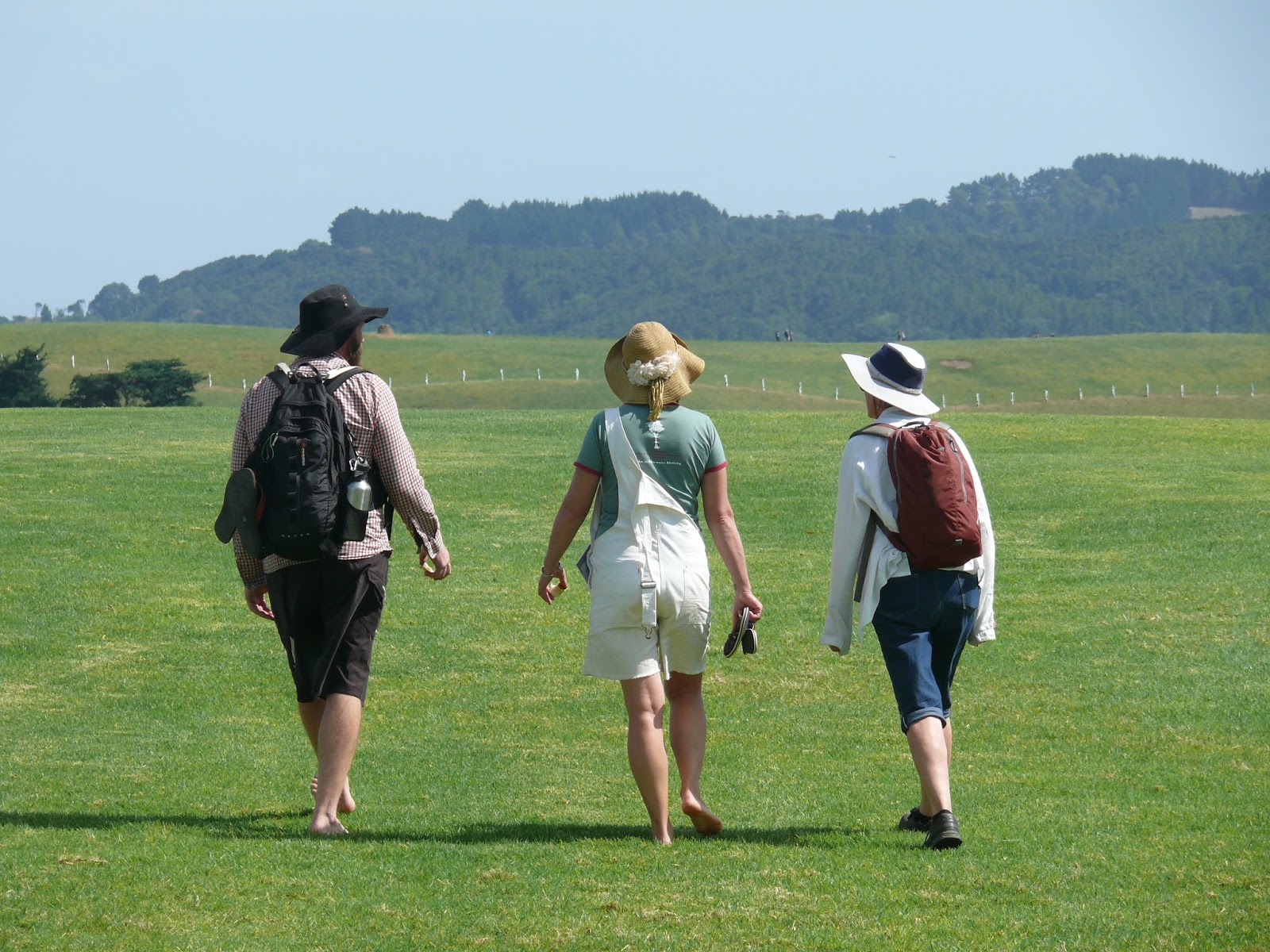
What a lovely day! A few months ago, after two years of trying, I finally got four tickets to visit this awesome place. It is free to visit but you have to book a place.

We had to get up a bit earlier than I'm accustomed to , needing to leave at 7.15am, but the morning was a very beautiful one.
 It was a lovely day, with just enough cloud to be interesting, and to keep us from being too hot. We were joined by friends from down the road, Paulina and Neil.
lan Gibb's 'Farm' is an amazing setting for oversize sculptures. 
 The 'farm' is mowed by pretty serious mowers, rather than grazed.

 Although there are a few animals, they are not, in the main, farm animals as we think of them.  Buffalo, emu, deer, alpaca, oxen, coloured sheep and goats.....


This giraffe is a sculpture though.

This, one of my two favourites, Horizons by Neil Dawson, is amazing. I thought that when I saw it,  it would look real, but no. In real life, even up close, it still looks like someone drew in on the landscape. Totally fucked with my head, and I kept blinking, trying to clear my vision. Wonderful.

 My other favourite was Anish Kapoor's Dismemberment


And here with Len Lye's Wind Wand in the background.

Paulina and I missed this one because, so Mac says, we were too busy talking. Meh - just makes for a good excuse to go back another time.
Some of the others, and some views of the land: photos really can't give much idea of the scale of these art works.


Richard Serra's Te Tuhirangi Contour is pretty impressive. It's about tracing the contour of the land, and 'collects the volume of the land', but to me it was a wall, but even though it's ends were free, it still seemed to have been effective, because we saw no Mexicans. Which was, perhaps, a shame.


 All in all, great art, great company, great day. I'll be back.


Wednesday, February 1, 2017

The 1960s: Mine, and Hidden Figures

Last night I went to the movies to see Hidden Figures, the blurb for which reads:
The incredible untold story of Katherine G. Johnson, Dorothy Vaughan and Mary Jackson - brilliant African-American women working at NASA, who served as the brains behind one of the greatest operations in history: the launch of astronaut John Glenn into orbit, a stunning achievement that restored the nation's confidence, turned around the Space Race, and galvanized the world. The visionary trio crossed all gender and race lines to inspire generations to dream big.
I was born in 1951. So the 1960s, the time in which the movie is set, covered, in today's terms, my school years from Year 5 to 13 plus my first year at university.

I remember the excitement surrounding the space race, the excitement and fear of the Cold War. I remember lying awake in bed, looking out my window at the stars, wondering if tonight would be the night the atomic bombs came. I remember that fear, nay, terror, which filled me especially strongly after my Standard Six (Year 8) teacher, Mr Thomas, taught us about the Cold War.

I remember the amazement and excitement, but also fear, when the Russians got to space first: Sputnik was a fabulous monster. I remember the excitement and pride when the Americans got there too, and the huge joy that surrounded the moon landing by the 'free world'. We didn't have tv, but were invited to watch it at friends of my parents.

At school, in those days, 'history' meant European history - British history plus, as described by my text book title, 'Europe Since Napoleon'. We learned little about colonialist New Zealand history, even less about Maori history, and what tiny bit I learned about America was mostly in relation to Britain, or to WWII (the Boston Tea Party, the bombing of Pearl Harbour in the Pacific.)

In my mid-teens, my mother bought me a magazine subscription one birthday or Christmas: the american 'Seventeen' magazine. Mostly for the fashions, so that she, and I with her help, could make clothes that were fashionable before other kiwi teens knew they were fashionable. But these also had articles in them that I read with complete bewilderment. Why were people upset about some people catching buses to school? I asked questions, which were mostly shrugged off, with, 'oh things are different there.' I couldn't seem to find out what 'desegregation' meant. I thought America wasn't like South Africa with it's apartheid system, yet there was obviously something weird happening.

You have to remember that back in the 60s in New Zealand only a few people had tv. In our house, we got our news from the NZ Herald, the pink-covered, picture-filled Auckland Weekly News, the NZ Broadcasting Corporation (National Radio), and the once a week, several weeks out of date, News of the World at our Friday movie night, held in the Te Kauwhata Town Hall. (Saturday afternoons in winter, the hall turned into a roller-skating rink.) There was no internet - hell, we still had a phone that hung high on the wall so I couldn't even sit down when talking, and no privacy - even if no one was around home, there was still the other people on the party line - Mrs Kearney for sure - and the exchange operator listening in! The local library was in a room about the size of our laundry, and no non-fiction. Information was hard to come by.

Racism was deeply embedded in our culture, and not recognised as such. Racism, back then, was what South Africa had, and the idea that Blacks there (I cannot use the words used for them back then) were lesser creatures, sub-human even, was only just starting to be questioned among the general population. Maori were regarded proudly as the most advanced of the 'native peoples'.

But gradually the ideas of the American civil rights campaigners, the feminists, the anti-apartheid campaigners, the anti-Vietnem War people, the 'make love not war' hippies started spreading, and in my years at university I absorbed many of those ideas.

Then came travel and children and homeschooling and depression and joy and So. Much. Learning!

When I look back at how much my ideas, and the world, have changed over my life, it astounds me. When I look at how much I am still learning and thinking and changing, it excites me.

But when I went to see Hidden Figures, it overwhelmed me. I re-experienced the excitement, the fear, the joy of those days. I remembered the terrible tears and fear when JFK was assassinated. I rejoiced in the lives of those amazing, brave women who stood up and created a doorway to a new world. And I cried all the way through, realising that all through those cruel and difficult times, I was living a life of white, privileged ignorance. Was? I still am! I am aware of it, but only when I think of it, and I can easily avoid thinking about it if I want. Some days I do just that - retreat into a media-free day and make art or garden or go to the beach. I don't HAVE to feel it all the time. That's a huge privilege.

In the era of Brexit and Trump I am increasingly aware that I need to stay aware, to stay in the world, and to do what small things I can to keep our world from the new Dark Age that seems to be threatening to eclipse our sun.


(ps - those amazing women learned FORTRAN and how to put it onto punch cards! I failed that three times at university! And I'm still clueless about hoe to work a computer properly!)

Sunday, January 29, 2017

Firewood Days

Last winter we had a tornado go through our area: this tree was ripped in half. It's pine nut tree, and it was the first year it had cones on it. Being a type of pine, the fallen part will presumably be good for burning, and we got a good trailer load from it.


A few days later we cleaned the driveway up  bit. Mac used the tractor to pull some of the big gorse out by the roots, and chainsawed up some of the bigger stuff. It's fantastic wood as it burns really hot.
The tornado also ripped a large kahikatea out of the ground, but when we went to look at it, found it was going to be just too hard to cut it up, and to get the wood out of the bush would need a lot more people and effort than Mac and I have.
 So, under the supervision of the flock of cockatoos, we sawed up a fallen gum tree instead.
 It's incredibly satisfying to cut your own firewood, and to clean up gorse and fallen trees at the same time. Sure beats doing housework! And best of all, my health has improved sufficiently for me to do some of the chainsawing again, for the first time in 3 years.
  We parked the trailer of wood under the pohutukawa tree for a couple of days before transfering it to the wood shed.
  Such glorious trees.
 They even make the old trailer beautiful!


Saturday, January 28, 2017

Weed Walk

I try to go for a walk most days, if only down the drive and to the short end of the road - which is just 1 km each way. I love how I see different flowers aka weeds each time.
I know these are noxious weeds, but the only way to get rid of them would be lots of poison, which would also poison the stream, so I just have to breathe and enjoy their glorious orange flowers.
There's the daisies, and then there's even more daisies: those tiny white dots are some sort of daisy-like flower but so small you can't tell until get right up close.
Dandelions are not really weeds: apart from their sunny smiles, they can be used for food and drink.
These were my favourite as a child: I picked large bunches of them on the way home from school to put in vases when I got home. Hint - they don't last long once picked.
 This is one I hate - it strangles trees, and I don't even like the flowers.
 But these, these are the very best!


Monday, January 2, 2017

Draw Every Day

Art has always been something for other people: I have never felt it was for me. I could always write, and I could work on my writing and get better at it, but art - I judged myself by my inability to draw or paint anything that looked like anything. However, colour, texture, shape all attracted my attention, and I loved doing art with my homeschooled sons and friends, and with my kids I never felt embarrassed by my inadequacies. I felt joyful when they did better than me, and learned so much, particularly from Simon, who taught me how to look at the world afresh.

My desire to create has increased over the years, and has found expression in craft work: sewing, knitting, fabric art, book binding, flag making. My book making has been evolving, very slowly, in a less formal, more expressive way, and involving the use of dyes, inks, stamps, stencils, stitching, collage and more.

Still, I'm not an artist. I still operate from a mindset that, as my school reports said, I lack talent and ability. I can't draw. Over the years I've bought and borrowed and read 'how to' art books, and been to classes, and given up.

The desire has never gone away, and a month ago I bought a book:
 I decided that the only way I'd ever learn to draw / paint was to actually practice - imagine that! This book has you draw every day. It has a page, or part of a page for you to use each day for a year. Each month has a theme (the first is 'nature',) and gives a brief tutorial, and tells you what art supplies to use (the first uses markers and a black pen.) Each day has a prompt. I have taken a deep breath and started yesterday - yes, on 1 January. Not a New Year Resolution so much as a determination.

I have been a procrastinator and a perfectionist most of my life - I put everything off because if I can't be sure I can do something perfectly, I won't even try. Not least because my mother and my teachers were of that generation who believed that the way to inspire children to do better was to point out all the things they did wrong, and to not praise anything in case the child stopped trying. No more. I have spent years trying to work out who I am. I'm still not perfectly clear on that, but I've come to the conclusion that I am too old to procrastinate any longer. I need to do as well as be - otherwise 'being' is pointless: if I am a creative person, I need to create, however badly. And I need to do it without shame or embarrassment - but that's going to take a bit of work!

My instinct is to hide what I do, but even though I know these aren't great, I also know that if I stick at it, the practice will not make perfect, but better, and there is pride, not shame, in trying. I must also say thank you to my wonderfully artistic son, Simon, for his encouragement. These are my first two days efforts.


Sunday, January 1, 2017

Weeds and Wood

Today we chopped out some big gorse from beside the driveway. As I walked down, I enjoyed plants that others would have pulled out as soon as they saw them. I leave them: there is so much joy in them, some 'weeds', some 'plants' gone to seed.

 Wild carrot - I love the little speck of red on some of the flowers.
 Silverbeet - isn't it gorgeous?
 Parsley.
 Parsley and dandelion.

 These were my favourites when I was a child.
 A little bit of loveliness between the garage and my bee shed.
And though gorse is indeed a weed, it has its uses: a nursery plant for natives; a food source for bees, and eventually, firewood. The gorse, combined with pine from a pinenut tree destroyed by the winter tornado, filled a trailer with plenty more to come. A good afternoon's work.

The Sun Sets on 2016

After dinner, when I ate more than I should have, we went for a walk to burn off calories, and to see the sun set on 2016. The clouds made it so much more beautiful than a completely clear sky would have been. But I've always been a cloud lover.


It's been a hard year for me. There are ups and downs in any year, but starting the year with a tooth infection, followed by waking up one morning to find I had gone near blind overnight, and thus discovering I had Type 2 diabetes, systemic candida and an extremely persistent urinary tract infection, all added up to a difficult and pretty traumatic year. On the plus side, without my awareness of my blood sugar levels, I would have stayed home with my feet up, instead of going for a walk on the best beach in the world.

Wednesday, December 28, 2016

This morning I weeded the asparagus garden, It has been sadly neglected pretty much always - maybe next year I'll have kept it weeded and we'll get more than a taste. Mind you, I've said that every year!

Simon and Zea headed off to the far north for New Year, and Jeff and Konny went into Hamilton to catch up with friends. It's been lovely having them all visiting, and good to see so many of their friends, and mine, over the holiday season. However, I was feeling shattered today until a visit from my oldest close friend, Eileen, meant a relaxing afternoon with no energy expended because I am so comfortable with her.

Meanwhile, the oldest goat lay down in the sunshine for a sleep today, and didn't wake up again. RIP Auntie, you were the nicest of the goats.

Mac attached the front-end loader to the tractor in order to bury her, and then followed up by filling with dirt, the old boat we acquired months ago from his brother. I dug the weak peppermint roots up from their spot under the pineapple sage and replanted it. Hopefully I won't have to buy any more peppermint tea ever again!


Tuesday, December 27, 2016

They've Gone: What's Left for Me?

my sons are gone
their partners, grandchild
the friends have gone
and (temporarily) the husband

it's just me left
so very quiet
i am alone, alone
without their presence

feel the silence
bone deep, nothing
beyond my breath
and the ringing in my ears


except for the purr
and the bark
the scratching and clucking
the quacking
the buzzing
the squawking of mynas
harassing the harrier

the stream splashes
down the rocks
the leaves murmmer
at the touch of a breeze
and in the distance
the muffled ocean roars
as it crosses the bar

Wednesday, December 21, 2016

Solstice, Procrastination, and Good intentions

Today it actually feels like summer at last. It is also the solstice, so it's about time it felt like summer!

Yesterday I went and collected 40 kumera tupu from Liz, our local permaculture guru, who lives just a few minutes away. The season is late here: last year I planted them in November. They grew well and now I know how to do it, they stored well too, and we are eating the last of them now.

I have not done well with producing food this year. I have been focused on getting healthier, on what I can and can't eat now I am diabetic, and have been fairly dispirited about growing food as a consequence. I am so disappointed that our fruit trees are not bearing much fruit this year, the ones that I can eat, anyway. I had planned on bottling lots of apples and pears, but we have no pears on our three trees, and not many apples.
I only recently decided to grow kumera again. Potatoes are definitely out for me, so haven't grown any, much to Mac's disappointment. However, I have found that I can take kumera in moderation. Of course, being both an impulse buyer (Hey I think I'll grow kumera again, I'll go get some tupu now,) and a procrastinator (I don't know what to grow in that garden so I won't prepare it for anything,) I got up this morning and knew I had to work hard in the hottest day of 'summer' so far (26C)
Of course, like all procrastinators, I am easily distracred. On the way to the kumera garden, I realised that the basket willows were lost in weeds so stopped to clean that mess up, 'pruning' some with the scythe in the process. I took this before I'd finished just so I could see what a mammoth task it was!

 My vege gardens have been similarly neglected, but the bees are loving it. There are actually young pea plants in there somewhere.
Anyway, I did manage to get the bed dug and weeded, but needed Mac's help after work to hit the warratahs in for the extended windbreak - not just to guard against the wind, but also in the hopes of keeping the pukeko out. I have only about a quarter of the shallots and garlic that I originally planted left, after the wretched birds kept pulling in out. They didn't like it, but had to keep trying, just in case the next one was different!
It was very hot, and hard work. I'm tired and my joints in my hands are throbbing from all the pulling of over-size weeds, but still, I feel incredibly privileged to live and work in this beautiful place.
It's been a funny week. I've spent time thinking about my parents, as my mother was diagnosed with terminal cancer 28 years ago yesterday, and died just 11 days later, following on from my father's death 8 months earlier. I've been thinking about my sons who have been through some hard times this year, but also some good times. I've been thinking of my personal difficulties with diabetes and depression this year - I've managed not to succumb to depression, but it's been a struggle nonetheless. But I've also been looking forward to seeing all my sons on the 25th, and to various 'happenings' coming up next year.

From my health problems has arisen a deep gut knowledge that I am going to die. I always knew it intellectually, but now I know it. This coming year I want to tell people if I love them. And what I love about them. Actually tell them, rather than wait and say it at their funerals. In the last week two people have said kind things about me, to me, and it felt so good. But it is also important to express the bad things if it is important to you and if the person is / has been important in your life. I never told my father anything other than I loved him. I tried to talk to my mother about the issues that have taken me the 28 years since her death to almost come to terms with - she refused to discuss or listen. I did tell her that I loved her, and thanked her for some of the positive things she had done - but only as she lay on her death bed. As I finished, she took one last breath and died. I don't remember her ever saying she loved me, or that approving of anything about me. I wish she had been able to talk to me, and to hear me.

I hope that people, my sons, friends, whoever, don't procrastinate, and will talk to me about what they need to say to me before I die, rather than saying the good things at my funeral, and the bad things to their therapists.
Today, in the garden, on this summer solstice day, I worked hard and didn't think much at all, just sat with the present. And it was good.


Wednesday, December 14, 2016

Relationships: Too Hard Some Days

When you never felt loved as a child, when you grew up thinking that you had to earn every scrap of affection, when you were always told that what you did was not good enough, you end up unable to believe that people care about you, love you. And you don't know how to manage relationships.

There are friends who, as I get a bit healthier, mentally, I realise weren't really friends at all, even though we filled functions for each other.: I was so desperate to be liked, I did whatever was needed to maintain their 'affection', and only realised recently that they didn't really give a fuck about me personally except where I was useful for their purposes. I'm not saying they are worse than me - just that, like me, they have needs.

There are other friends who do care about me, as I do for them. People who ask how I am, and what I've been doing, and listen when I answer, as often I do with them. People who I enjoy, and who seem to enjoy my company too.

I've reached a point where I have been able to let some just drift away. If they come back, and I can see a change in the way we interact, I won't turn my back on them.

The hardest relationships to manage are those with my sons. They are adults, grown and leading their own lives. But my love for them is still every bit as strong as it ever was, as when I fell in love at first sight when each was born. And yet they are drifting further and further away. I don't know most of their friends. I no longer know all the things they like to eat. I know little about their interests or their opinions or about what matters to them anymore. Mostly they don't seem to want me to know, and mostly aren't interested in my opinions or in having conversations about much.

I sometimes know they love me, but not always. I sometimes think they like me, but not always. I sometimes think they trust me, sometimes, some more than others. I miss knowing these people who I love so much, more than anyone or anything else in the world, but I am required to smile and act glad that they are becoming more independent, more their own unique people, leading their own lives. To smile, and be grateful for the morsels they share.

I remember thinking that the reason our memories of childbirth fade so quickly is because otherwise a woman would not give birth a second time - let alone a third and fourth time so it! But what would really kill off the human race, would be foreknowledge of the pain of successfully raising independent children. Some days it's just too fucking hard.

Saturday, December 10, 2016

Thoughts Around Food

Since someone was talking to me the other day about becoming vegan as an ethical choice, I've been thinking again about how I make my food choices.

I became a vegetarian in the early 1970s, after I left home and went flatting. I had never liked eating most meat, and, in particular, disliked the texture. I liked pork, ham, bacon, but nothing else. Back in those olden days, vegetarianism was pretty unusual and I frequently faced questions from people who were sure I'd die if I didn't eat it. I started reading about being a vegetarian, and attended a vegetarian cooking / nutrition class run by the Seventh Day Adventists. No Google or internet back then. I quickly realised that if I was worried about health, pig meat was probably the most important one to give up, and a few weeks working at the Huttons factory in Frankton made giving up pig meat an easy decision!

My interest in learning more about staying healthy led me to the Soil And Health Association in Hamilton, and from there developed an interest in organic growing, and so on through wider areas of healthy eating. Obviously I came in contact with the ideas of veganism and animal welfare, but my interest was mainly in factors that related to my health. I bought free range eggs when I could, and continued to eat dairy products and honey from 'wherever'.

In 2000 we moved to a block of land in the country where we try to grow as much food as we can, though I admit I could do a lot more if I was a real yeoman farmer / peasant - I don't work in the cold and rain, nor put in the hours that are needed to be properly productive. I did a permaculture design course, and continue to read widely in these areas. I started understanding the other ethical issues involved in food production

When I buy food, I take into account a variety of things. First and foremost, I no longer buy food that will harm me - as well as being vegetarian, I am wheat-free (doctor's orders) and diabetic.

I buy as little processed food as I can, preferring to make my own from scratch, ensuring ingredients are as fresh as possible, and necessary for the eating rather than for shelf life.

I buy organic as much as I can find and afford, partly because so many fertilizers, herbicides and pesticides have far reaching effects on non-target species. I avoid GM food because it is designed to increase the amount of herbicides and insecticides that can be used, again affecting non-target species. Because of labeling law inadequacies, buying organic is the only way to avoid these. Veganism for reasons of not killing animals, needs, in my opinion, to be organic, and fairtrade, because standard food production thrives only with a huge amount of herbicides, pesticides, insecticides, fungicides - but I guess it depends on your definition of  'animals'.

I buy as local as I can, Raglan first, then Waikato, North Island, South Island, Australia, Pacific Islands and so on. I rarely buy imported fruit and vegetables. The other day I wanted some frozen blueberries and raspberries but couldn't find any that were NZ produce only - so I'm going without until I do my annual pick-your-own in a few weeks time and freeze enough for the coming year.

I buy fairtrade as much as I can find and afford. I don't want to buy food that has been grown using exploitative labour.

I try to avoid plastic where practicable.

All of these things, other than my dislike of the taste and texture of meat, reflect values that are important to me: the importance of keeping healthy, not just myself, but the earth. Of treating people and animals well. The permaculture ethics of earth care, people care and fair share, plus the ideas of the slow food movement and food security are pretty much what guides my thinking. I understand the ethics of people who become vegan, both the land use issues and the issue of killing animals in the process of food production, but not for the first time, I have concluded it is not for me. To eat as a vegan at this point in time, would require me to compromise too many of my other areas of concern.